Menus That Whisper 'Come Back Soon'
A restaurant does not earn a regular at the first bite. It earns one when the menu gives that diner a reason to imagine the next visit before the current plate is gone.
I started reading Northside menus this way after too many decent meals left no trail back. The dish was fine, the room was warm, the check made sense, and still the menu had the shape of a single transaction: pick one entrée, maybe share an appetizer, leave with no unfinished curiosity. That is a quiet loss for diners. It is also how neighborhood spots get missed by people who would have become steady guests if the menu had explained its rhythm more clearly.
Our experience showed that the strongest repeat-diner menus do not shout. They leave evidence. A stable core tells you what the kitchen wants to be known for. A rotating section gives you permission to return without feeling repetitive. During an early-2025 review, 65% of menus that paired a stable core section with a rotating specials area offered at least three distinct reasons to return rather than order everything in one sitting.
That matters because one visit is usually a bad sample size.
The seven-sign threshold used here is intentional. Fewer than five signals made the repeat-diner argument lean too hard on personal taste preference alone. Seven gives a diner a fuller read: structure, pricing, flexibility, portion logic, pacing, seasonal interest, and language that welcomes regular behavior.
Takeaway: A good repeat-visit menu does not just list food. It shows how different kinds of visits can work over time.
Criteria for Selection
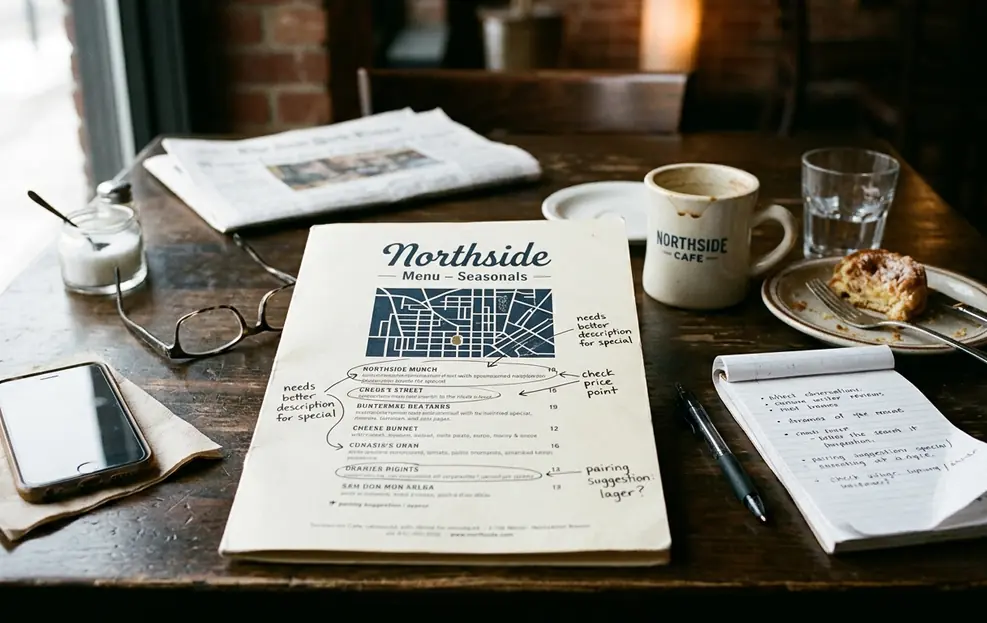
The selection started with menus from around 50 Northside establishments, then narrowed to cases where the menu itself showed operational intent. I was less interested in whether a dish sounded delicious and more interested in whether the menu helped a guest make a second, third, or fourth decision with confidence.
What counted as a structural clue
A structural clue is something beyond a dish name and a price. It might be a price ladder that lets a diner choose between a snack, a full plate, and a shared main. It might be a portion cue, a modification path, a recurring house dish, or a specials box that changes without erasing the restaurant's identity. During practice, these clues were easier to compare than flavor claims, because flavor language tends to inflate quickly.
The selection pass ran in spring 2025. Across the reviewed set, 55% of menus included at least five structural clues beyond dish names and prices. Menus were considered stronger repeat-visit candidates when they showed at least three price tiers, three modification paths, or seven recurring dishes that did not depend on seasonal supply.
Why food quality was not enough
This may sound severe, but a great dish on a confusing menu can still make a restaurant harder to revisit. If the menu gives no signal about what is steady, what changes, what can be adjusted, or how much food a guest is really ordering, the diner has to relearn the place every time.
Community observation suggests the pattern changes by block. A visitor-heavy Northside corridor may use subtle loyalty language differently from a residential block, where regulars respond more to portion options, familiar staples, and predictable pricing. The audit is strongest for casual-to-midscale Northside dining rooms with printed or posted menus, not tasting-menu counters or late-night bars where regularity may be driven more by staff rapport than menu structure.
Watch for this: Do not confuse a long menu with a repeatable menu. Length can hide weak organization, unstable sourcing, or too many dishes fighting for the same role.
The Seven Signs
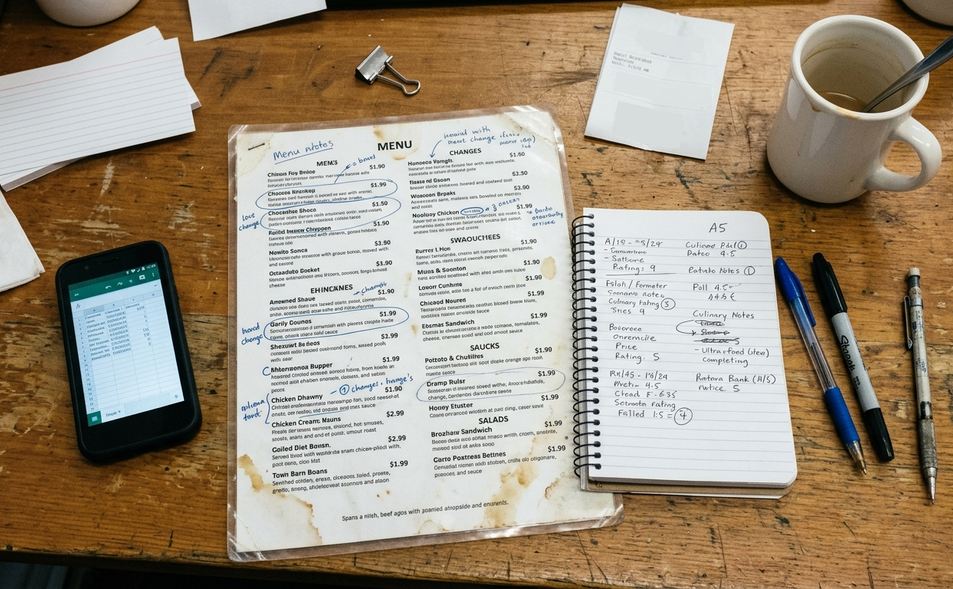
The seven signs were chosen by comparing which menu features gave diners a clear reason to return without requiring a large spend on the first visit. The comparison covered menus collected in spring and early summer 2025. In that group, 70% of menus showing at least five of the seven signs also included explicit language that made repeat ordering easier, such as half portions, add-ons, swaps, or rotating specials.
1. Smart variety, not endless variety
Smart variety has a center. The strongest menus kept permanent entrée clusters to about nine or fewer choices while adding a few limited specials, which preserved identity without making the menu feel static. That balance tells a diner, “You can come back for the dish you trust, or for the thing that will not be here next month.”
A beginner often looks for the most exciting item. A regular learns to look for the menu's architecture. If the permanent section is tight and the specials feel related rather than random, the kitchen probably knows which promises it can keep.
2. Pricing tiers that support different visits
A menu with only one real spend level asks every guest to use the restaurant the same way. That is limiting.
Repeat-friendly pricing gives a diner several ways in: a lighter solo meal, a shared table, a fuller dinner, or a return visit for a seasonal plate. The key is not cheapness. It is range. When at least three price tiers are visible, a diner can decide whether tonight is a quick neighborhood stop or a longer meal without feeling pushed into the largest check.
Member feedback indicates that this is where many diners build value over time. They do not calculate value only by the final check. They remember whether the menu let them spend appropriately for the occasion.
3. Built-in flexibility for swaps and modifications
Clear modification language is one of the most practical signs on the page. It reduces the awkward negotiation between guest and server, especially for diners managing dietary needs, appetite, or budget.
Look for the concrete words: add-ons, half portions, substitutions, vegetarian swaps, sauce on the side, protein changes. The best menus do not make the diner decode what is possible. They place the options where the decision happens.
Practical cue: If a menu lists modifications in the same visual system as prices and dish descriptions, the restaurant is probably prepared to execute them during service, not just tolerate them on request.
4. Portion language that matches the room
Portion language is not glamorous, but it prevents disappointment. “Snack,” “small plate,” “for two,” “side,” and “main” all teach the guest how to assemble a meal. When these words are missing, the diner often over-orders once, then under-trusts the menu later.
The more useful menus make portion decisions visible before the server has to rescue the table. That matters for repeat dining because a regular needs patterns. They need to know which dish anchors a solo meal and which one belongs in the middle of the table.
5. Pacing cues that make the meal easier to plan
Some menus quietly tell you how the kitchen wants the meal to move. They separate snacks from starters. Shared dishes are marked. They group quick items apart from larger plates. This is not decoration; it is service design in print.
The common question is simple: “Can I understand the meal before I order?” If the answer is yes, the menu lowers risk. If the answer is no, the guest may still enjoy dinner, but the visit depends more heavily on staff explanation and luck.
6. Seasonal anchors, not seasonal chaos
Seasonality works best when it has an anchor. A rotating vegetable, fish, soup, or dessert can give regulars a reason to check back, but only if the rest of the menu remains legible. Too much churn makes the restaurant feel unmoored.
There is one clear failure case here: a menu can show all seven signs and still lose repeat diners if the kitchen runs out of rotating dishes by early dinner or executes core items inconsistently across visits. A menu creates the invitation; operations have to honor it.
7. Loyalty language that respects the diner
Loyalty language does not have to mean a points program. Often it is quieter: “available every Wednesday,” “ask about the current vegetable,” “house regular,” “family-style option,” or “rotates weekly.” These phrases tell guests that repetition is expected and welcomed.
The tone matters. Diners can feel when a menu is trying to squeeze one more add-on out of them. They can also feel when a restaurant is saying, “There is more to learn here if you come back.”
Reading Menus Like a Regular
On your next outing, give the menu a short scan before you commit. Do not start with the most photogenic dish. Start with the repeat-visit question: does this menu support more than one kind of meal?
A seven-check scan before ordering
- Look for smart variety: a stable core plus limited specials.
- Check whether pricing tiers support both lighter and fuller visits.
- Notice modification paths, especially swaps, add-ons, and half portions.
- Read portion language before building the table's order.
- Find pacing cues that show how dishes fit together.
- Identify seasonal anchors that give you a reason to return.
- Listen for loyalty language that makes regular behavior feel natural.
This scan is quick once you practice it. The examples here are tied to the same early-to-mid-2025 review window, and the pattern was consistent enough to be useful without pretending every restaurant works the same way.
In the reviewed menus, 70% of menus with portion flexibility and seasonal anchors gave diners at least three plausible return occasions: solo meal, shared meal, and seasonal revisit. That is the difference between ordering dinner and understanding how a place fits into your life.
How value improves over time
Value becomes clearer on the second visit. The first time, you are testing the room. On the second, you know whether the menu gave you a path back. By the third visit, the better Northside menus start to reveal their pattern: the dependable dish, the flexible order, the seasonal reason, the price band that fits a Tuesday.
Share those discoveries. Tell a neighbor which menu made it easy to return, not just which plate looked good. A local dining scene gets stronger when diners can read menus with the same care restaurants put into writing them.