What You Gain or Lose by Choosing the Wrong Model
A successful dining experience begins long before you look at menus & dishes. The foundation of the night rests on fixed constraints. You must account for your party size, hard arrival deadlines, transit schedules, and whether your group is comfortable standing by a busy host stand. Mismatching your seating strategy to these realities can turn a planned evening into frustration.
Finding the right fit aligns with your group's spontaneity needs and tolerance for uncertainty. The highest-friction dinner window for many neighborhood dining rooms often falls Thursday through Saturday, 6:30 p.m. to 8:30 p.m. Arriving in that range without a booking should be treated as a wait-management plan, not a guaranteed meal time.
Party size dictates your options. A party of five or six creates a fundamentally different seating problem than a party of two. Hosts may need to combine tables or wait for a specific booth to clear. A pair can often be placed at a bar, counter, or small two-top with minimal friction.
Flexibility Versus Certainty
Walk-in dining rewards last-minute decisions. It preserves the option to leave the house later, change your preferred cuisine on a whim, or add a stop before dinner. Applying basic restaurant insights to your evening reveals that shifting your departure by in the ballpark of 20 to 40 minutes usually requires no contact with the restaurant. The cost is that the queue may lengthen significantly once the dining room enters its 6:30 p.m. to 8:30 p.m. rush.
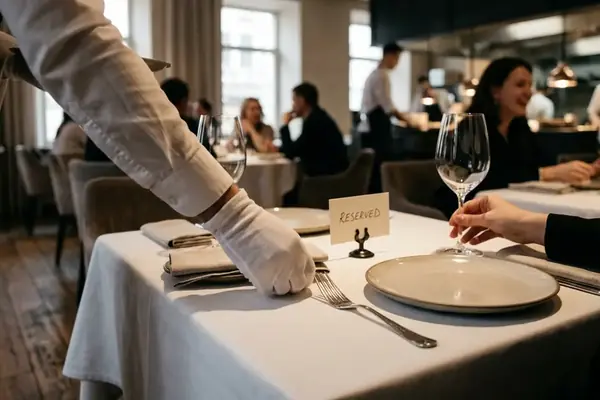
Reservations trade that freedom for certainty. They lock in your timing but limit changes once booked. Many dining rooms use arrival grace windows hovering around 10 to 15 minutes. They may release the table after that window expires, especially on busy Friday and Saturday evenings.
Consider a common failure case. A party books a table for 7:30 p.m., but one guest arrives at 7:50 p.m. If the restaurant’s grace window is 10 to 15 minutes, the table may be released entirely, or the group may be reseated much later in the evening.
Warning: Late arrivals on a reservation don't just delay your meal; they risk forfeiting the table entirely during peak weekend hours.
How Each Model Shapes the Evening Atmosphere
The seating model directly dictates the room’s rhythm and the overall food culture of the space. A diner who wants motion, bar chatter, and visible turnover should lean toward a walk-in-friendly room.
These energetic spaces often rely heavily on bar seats, counters, and closely managed two-tops. Those specific areas can turn faster than large tables because guests may simply order drinks, snacks, or a shorter meal. Natural turnover creates a vibrant, busy room.
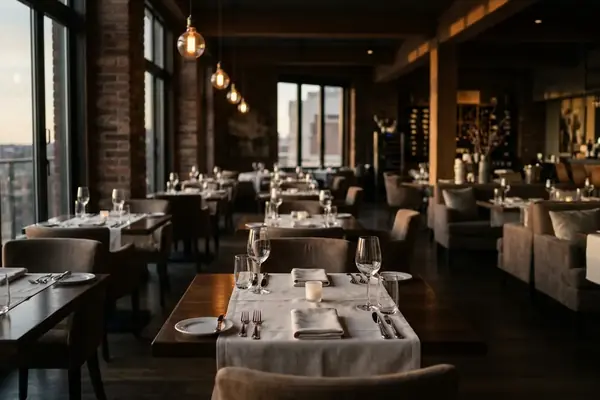
Conversely, reservation-only rooms tend toward measured pacing and quieter tables. Reservation-led rooms commonly stagger arrivals in 15 to 30 minute blocks. This structure helps keep the host stand, kitchen, and servers from being hit by every table at the exact same minute. A diner who wants the meal to unfold at a steady, uninterrupted pace belongs in this kind of room.
Managing Waits and Timing Your Arrival
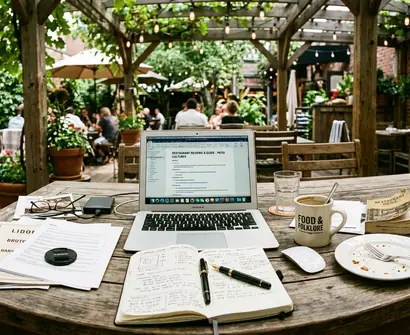
A sound walk-in plan is constructed before you leave home—long before you reach the host stand. You must check whether the restaurant actually accepts walk-ins, identify one nearby backup, and pick an arrival window that avoids the main crush.
For walk-ins, the more workable arrival windows are often early dinner, 5:00 p.m. to 5:45 p.m., or late dinner, 8:45 p.m. to 9:30 p.m., across multiple seasons. Avoiding the central 6:30 p.m. to 8:30 p.m. window is crucial.
While seating patterns provide a useful baseline, restaurant capacity can shift fast with sudden weather events. A Northside patio closure from rain or cold can instantly remove outdoor seats during the 6:30 p.m. to 8:30 p.m. window. This turns a normally easy walk-in into a long wait.
Details shared by hospitality operators indicate that if a host quotes a wait longer than 30 to 45 minutes, a group with a fixed end time should switch to its backup. Waiting until hunger and timing pressure mount makes the decision worse.
One catch exists. Ticketed tasting menus, private dining rooms, and prepaid holiday meals do not behave like ordinary reservations. The restaurant may have already committed labor, ingredients, and table pacing to a fixed headcount.
Pro Tip: Checking local restaurant guides before you leave home gives you a neighborhood favorite ready as a backup.
Decide Before You Leave Home
The final step in occasion-based dining is committing to your strategy. Before leaving, make the call in one pass. Confirm the restaurant’s current policy, compare it with your group’s patience level, and decide whether the night is built around a specific table or around flexibility.
For a same-day reservation attempt, check availability during the mid-afternoon window, 2:00 p.m. to 5:00 p.m. By early evening, released tables may already be claimed, or the host may be managing only in-person arrivals.
For groups of four or more, review the booking policy 24 to 72 hours ahead when possible. Larger tables are fewer in number and may carry stricter cancellation or deposit rules. Local hospitality boards have long emphasized the importance of respecting these cancellation windows.
Key Takeaway: Always check same-day availability between 2:00 p.m. and 5:00 p.m. before assuming a dining room is fully booked.
Open your preferred booking platform right now and check the 2:00 p.m. to 5:00 p.m. availability window for tonight's target restaurant. If no tables appear, immediately text your group to confirm they are willing to eat at 5:45 p.m. or stand in line for your designated backup spot.