Losing the Night to a Mismatched Seat
At the host stand for a 7:30 Saturday reservation, the couple first identifies the night's purpose. The restaurant operates at peak capacity, and the floor plan is fully committed. They must decide if they require uninterrupted conversation, a view of the cooks, a quick meal, or complete privacy. The host then maps that specific purpose to either the kitchen's clock or the dining room's clock before assigning seats.
A mismatched seat spends the check on a room that fights conversation, rushes the plates, or hides the cooking the guests came to watch. A correct booking helps the night match the reason the party went out. The consequential details of this assignment are the seat's physical distance from the pass, the kitchen door, the point-of-sale terminal, the overhead speakers, and the main server route. Guests should use the two to five minutes before seating to confirm whether the reservation means a pass-facing counter stool or merely a bar seat.
Pre-Seating Verification Tactic
Always verify the exact location of the seat before accepting the menus. A quick visual check prevents a two-hour commitment to an unsuitable location.
For a 90- to 120-minute dinner, an unsuitable noise level or a rushed service pace affects the majority of the evening rather than just a brief opening stretch. The initial choice dictates the rhythm of every course that follows. A practical approach is to state the evening's priority directly to the host upon arrival.
The Heat and Metronome of the Kitchen Counter
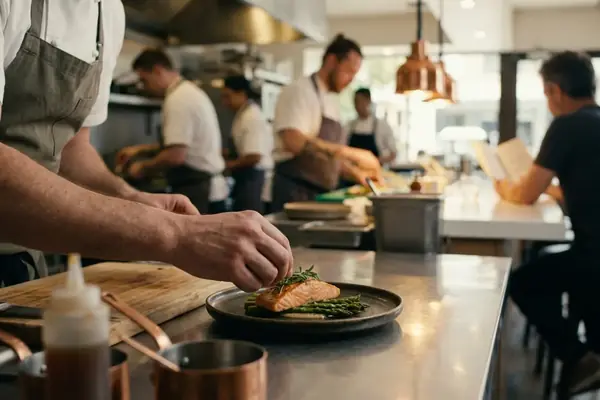
The decision to sit at the counter begins strictly with sightlines. A diner checks whether the stool faces the ticket rail, the pass, the heat lamps, the plating surface, or the live-fire station. The counter operates as a working edge of the line. The cook's timing becomes the evening's metronome. Menu format and expected meal length enter the choice only after establishing that visual connection.
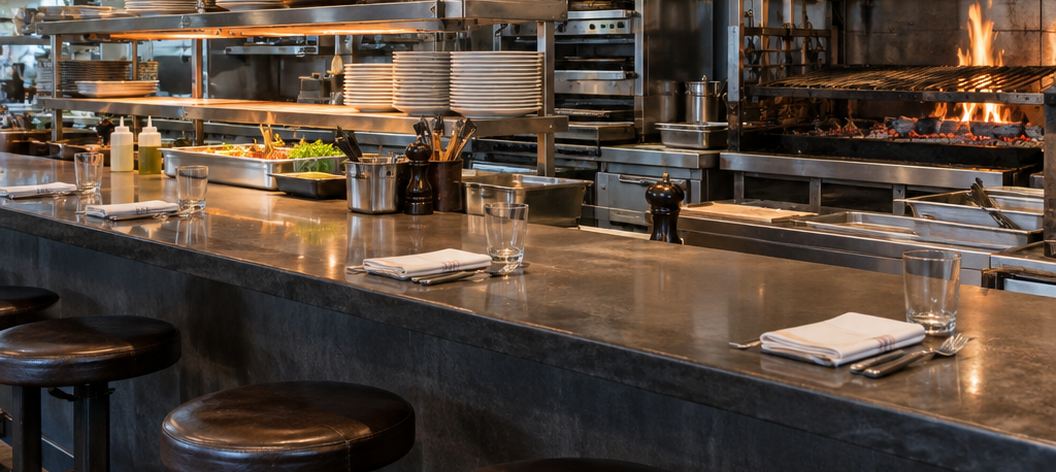
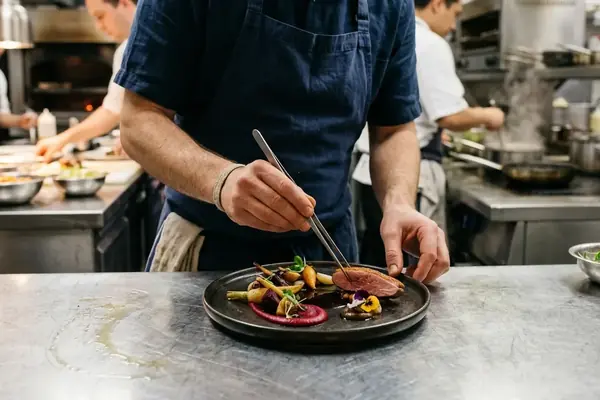
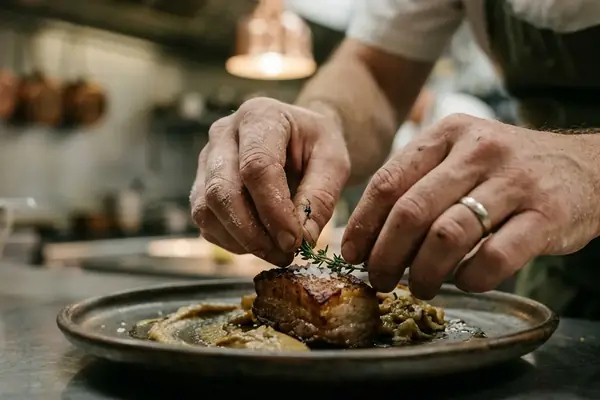
Observations across Northside full-service rooms indicate that plates, cook-server questions, and ticket calls repeatedly interrupt long conversational turns at pass-facing seats. The environment supports food talk while complicating a private catch-up. A true kitchen counter exposes the entire operational sequence from ticket arrival to firing, plating, sauce work, pass inspection, and server pickup. The view of the cooking is the main attraction. Guests see the fire and the last-second sauce work, accepting the trade-off that they also see the scramble.
Diners should assess the counter during the restaurant's stated peak window. The host can often identify this peak within a range such as 7:00 to 8:30 p.m. Judging the counter's energy from an empty-room photograph leads to inaccurate expectations. Guests must ask whether counter bookings are held to a defined 90- to 120-minute seating and whether courses follow a fixed tasting sequence or can be slowed down. The counter demands attention and participation in the kitchen's momentum.
Buying Distance and Rhythm at a Dining-Room Table
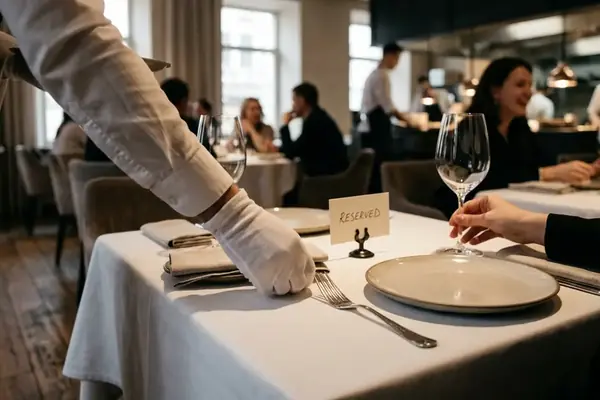
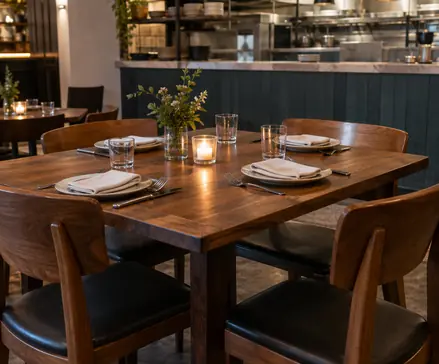
For a table, the booking decision shifts entirely from kitchen visibility to acoustic and physical insulation. A table buys distance from the line. The guest asks where the two-top sits relative to the kitchen door, the service station, the speakers, and any large parties. They choose a corner, wall, or banquette position that lets the server—not the pass—control interruptions.
Physical buffers include the space between parties, an upholstered banquette, a wall-facing seat, table linen, and a server route that avoids cutting between diners. Conversation can hold a full arc. Birthdays, negotiations, and first dates thrive here because the kitchen acts as a backdrop. Diners lose the plating theater and most of the heat and smell of the line. The cooking arrives finished.
A party planning a bottle and several courses can ask whether the table is booked for 90 minutes, two hours, or left open-ended before selecting the reservation. For a later meal, diners compare arrival windows such as 8:30 to 9:15 p.m. with the kitchen's closing time. A thinning room is useful only if the full menu remains available to the table. In the dining room, the guests have more control over the pace.
Mapping Pace, Conversation, and the Final Check
The seat is compared on four axes in order: desired pace, required conversation, value of the kitchen view, and likely check structure. The host's description of the physical seat comes before any assumption about speed or volume. Counter courses commonly key off station readiness and pass pickup. Table pacing can be mediated through the server, with pauses requested before firing the next course.
The counter favors short exchanges about dishes and technique. A table better supports a discussion with a sustained arc. Counter seats show fire, hands, garnish, and the final wipe of the plate. Tables substitute a view of the room and present each dish after the kitchen work is complete. Guests must confirm whether the counter uses a tasting menu, an à la carte menu, a seat minimum, a reservation deposit, or a chef's-counter supplement.
- Pace: Counter timing relies on the kitchen; table timing relies on the server.
- Conversation: Counters suit brief exchanges; tables support long discussions.
- View: Counters offer culinary theater; tables offer room ambience.
- Cost: Counters may have supplements; tables increase checks through longer stays and beverages.
At a table, bottle purchases and a longer sequence can raise the check without a seat surcharge. A two- to four-minute call made one to three days before the reservation can establish whether the counter is a chef-facing experience, overflow bar seating, or a pass-through beside the point-of-sale terminal. The six-stool pass-to-POS seat breakdown illustrates how quickly the experience degrades if the seat is misaligned with the guest's expectations. Securing the right seat can improve the meal.
Aligning the Party's Behavior with the Floor Plan
The diner assigns the seat according to the party's actual behavior. Solo guests and pairs who will watch the line treat the counter as the entertainment. Groups, guests who rely on clearer speech, and parties carrying an important conversation prioritize a table with controlled traffic and fewer kitchen interruptions. A counter is most coherent for one or two diners, particularly when the intended meal is a compact 45- to 75-minute visit or a chef-led sequence.
Parties of three or more should confirm whether counter stools permit face-to-face conversation or force everyone into a straight line. For guests sensitive to noise, ask about speaker placement, ticket-printer location, open-kitchen calls, and the distance between the requested table and the kitchen door. This guidance addresses full-service restaurants with a distinct kitchen pass and dining floor; café counters and banquet layouts operate differently.
Trade-offs stop being worth it when the counter is just leftover bar stools with no view of cooking—or when a 'quiet table' sits on the kitchen door. The kitchen-door two-top versus corner-banquette boundary defines the limit of acceptable compromise. A clear understanding of the floor plan prevents these common booking errors.
A Saturday Night Booking Walkthrough
In the worked case, a couple is choosing between two stools at a six-seat kitchen counter and a dining-room two-top for Saturday. Before opening the reservation page, they write one sentence: either "We need an anniversary conversation" or "We want to watch the wood oven." Seven to fourteen days before dinner, they contact the host.
The model restaurant has six counter stools, one dining-room two-top under consideration, and a target Saturday arrival of 7:30 p.m. The booking inquiry covers five items: counter length and orientation, expected noise, menu format, seating duration, and any counter-specific premium. They arrive five to ten minutes before the reservation so the host can verify the exact stools or table before the party is committed to a course sequence.
For the anniversary dinner, they choose the dining-room two-top after the host confirms it is away from the kitchen door and allows time for a bottle and several courses. For the wood-oven dinner, they take the counter stools only after confirming that both face the line and carry no unexpected premium.